Wednesday, January 26, 2011

genesis and its contemporaries

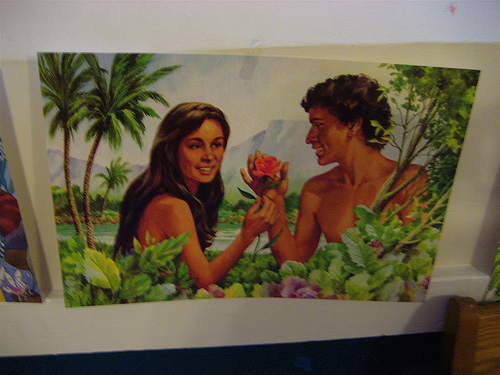
I was surprised to find both in my reading of Genesis and in subsequent scholarly research how inconclusive the text is regarding why Cain’s offering is rejected. This seems to be an integral aspect of the story, because one of the great lessons to be learned is how to please God and the lack of an explicit discussion regarding what God seeks in the offerings. One common theory about why God rejected Cain’s offering is because of its bloodless nature. However, it seems unlikely that God give a preference for live offerings over bloodless offerings for a few reasons. First, God seems to show great reverence for the land when he assigns Adam to “till the ground from whence he was taken” (Genesis 3:23). Instead, it seems likely that the greater use of adjectives referring to Abel’s offering distinguishes it implicitly from Cain’s. Abel “brought of the firstlings of his flock and of the fat thereof” (Genesis 4:4). However, “Cain brought of the fruit of the ground an offering” (Genesis 4:3). Some scholars argue that “by offering the firstborn Abel signified that he recognized God as the Author and Owner of Life,” and the accompanying descriptor of Cain’s offering as being of the ‘firstfruits’ is intentionally missing (Waltke 368). While this explanation is certainly not definitive, it makes greater contextual sense to me instead of the ‘bloodless’ theory that many assume. It seems likely that if the ‘bloodless’ hypothesis were true, the author would have emphasized the blood in its description of Abel’s offering. There were also striking parallels between Cain and Abel and the excerpt from the Jungle Book. In the final story with the Tiger, the Tiger “killed the buck, and thou hast let Death loose in the Jungle” (57). The Tiger is singled out for committing the first murder of the animal kingdom, much like Cain. There is even a ‘scar’ imposed on the animal kingdoms, with the “black stripes upon his flank and his side” resembling the marks left because of Cain’s murder (58).
tiger

Paradise Lost offers some interesting commentary about the Tree of Knowledge. Eve provides two reasons why she should not eat from the Tree of Knowledge. Later in her conversation with Satan, she claims that “God so commanded” for her to not eat from the tree (652). However, earlier in the conversation, the speaker reveals his voice and refers to the tree as the “root of all our woe” (645). This analysis of why the tree should not be eaten utilizes a consequentialist justification. While this provides an interesting interpretation for why the tree should not be eaten from, some implicit anthropocentric analysis is also given regarding the tree. In the face of the tree, many animals saw the tree as they “longing and envying stood, but could not reach” (593). I am not claiming that this is anthropocentric because it underestimates the physical capabilities of the animals. Rather, this analysis seems to imply that animals do not have the choice to fall outside of God’s approval because they were never within the purview of God’s watch in the first place.

adam and even posing with the tree of knowledge

Bruce Waltke. “Cain and His Offering”. Westminster Theological Journal 48 (1986). Page 368.

Monday, January 24, 2011

Ishmael Three

In the closing chapters of Ishmael, Daniel Quinn explicitly reveals his view of the causality of the exploitation that he critiques throughout the novel. In doing so, Quinn explicitly distinguishes his view from many other theories prominent in the social sciences. Ishmael explains to the narrator that “the world of the Takers is one vast prison, and except for a handful of Leavers scattered across the world, the entire human race is now inside that prison” (251). In a way, Quinn is arguing that humanity enslaved to its desires. The narrator eventually reaches the conclusion that the goal of this prison industry is “consuming the world” (252). As a result, Ishmael places the shifting of consciousnesses and grassroots education at the forefront of its strategies for resistance. This runs in the face of the strategies of many prominent Leftists, who give preference to social justice amongst humans. Ishmael argues, “What is crucial to your survival as a race is not the redistribution of power and wealth within the prison but rather the destruction of the prison itself” (252-3). In the view of anti-capitalists, “avoiding giving central importance to the emancipation of labor - tends to vitiate the anarchist reading of things, and loses concreteness” (Kovel 197-8). By denying the importance of internal hierarchies within humanity, Daniel Quinn is distinguishing his solution from the frequently accepted social critique from Marxist schools of thought. For Quinn, only a confrontation with desire and our own complicity in the system through the education of other individuals can bring systemic change.
prisoners

Some interesting analysis is also presented regarding racial diversity. When drawing the distinction between rearranging hierarchies within the prison and overthrowing the prison overall, Ishmael concedes that “white males—have called the shots inside the prison for thousands of years, perhaps even from the beginning” (252). By making this concession, Ishmael acknowledges that racial hierarchies are a systemic problem in the social order. Ishmael views the broader movement that he is attempting to initiate as being a solution to these racial striations. The complete rejection of consumer culture is “a common cause to which all humanity can subscribe” (253). It appears that Daniel Quinn views this social cause as one that the entirety of humanity can rally around, providing an opportunity for an inclusive and racially diverse society to emerge from the ashes of the waste and greed that characterize the status quo.

racial diversity


Joel Kovel. The Enemy of Nature. Zed Books: New York (2007). Pg. 197-198.

Wednesday, January 19, 2011

Ishmael II


I found Ishmael’s reading of Genesis to be extremely provocative. I think a crucial element to keep in mind when attempting to approach his reading of Genesis is to analyze it with the right methodology. Daniel Quinn does not advance his argument with the intention of uprooting decades of anthropological and historical analysis of Biblical texts. Rather, Quinn’s project should be analyzed in terms of how useful it is for establishing a counter-history of society. Ishmael acknowledges himself that “many of these people had their own tales to tell of this revolution, their own ways of explaining how these people from the Fertile Crescent came to be the way they were” (175). This seems to acknowledge the entirely subjective and arbitrary nature of the Old Testament texts, with their origins in the spoken word tradition of history. As a result, it would be foolish to assume that Ishmael strives for historical accuracy. Despite this different lens that I used to examine Ishmael’s re-reading of Genesis, I still have my apprehensions. It seems pretty self-evident that the elements of society that propagate the environmental exploitation that Ishmael is concerned with (Statist bureaucracies and profit-driven corporations) are largely secularized. Their rationality is hardly contingent on myths espoused millennia ago. They are informed by normalized discourses, many of which are the product of Western Enlightenment’s renunciation of any thought separate from Reason.

Adam and Eve


I also felt like the passage about ‘the crash’ was an extremely important section of the assigned reading. Ishmael is correct in pointing out the flawed logic of optimists who claim that “we must have faith in our craft” because “it has brought us this far in safety” (109). While these ideologues of the status quo utilize flawed logic, this does not necessarily suggest that a Malthusian world view is safe or productive. This paragraph becomes almost scary when Ishmael invokes fear-mongering rhetoric: “Five billion of you pedaling away—or ten billion or twenty billion—can’t make it fly. It’s been in free fall from the beginning, and that fall is about to end” (109). Ishmael’s invocation of Malthusian discourses still reinstates “the spatial code of modernization theory which draws a line between developed and underdeveloped regions” (323). Although this line-drawing may appear neutral, it has insidious implications for Western development policies. As a result of neo-Malthusian discourses, the motivation for development policy “is not so much the quest for food of hungry millions that demands the dismantling of traditional agriculture in the name of political stability, but rather the pressure of these faceless masses on more or less pristine ecosystems in remote areas” (330). It is evident how such discourses justify “discriminatory land policies and “coercive conservation”” being imposed upon the Third World by Western countries (331). The ability for Ishmael (and thereby Daniel Quinn’s philosophies) to be coopted by other neo-Malthusians becomes apparent as many of them publicly “maintain that “nothing less than the kind of commitments so recently invested in the Cold War” is needed to halt current trends” (331). I agree that both Ishmael and Daniel Quinn would oppose such coercive policies being imposed by the West. However, the discourses deployed by Ishmael have empirically been used to justify such neo-colonialist phenomena. Perhaps framing the problem in a less catastrophic context would avoid such repercussions for policymaking. After all, what empirical evidence does Ishmael possess to warrant his claim that the crash is coming? Scientific evidence is inconclusive about many aspects of the resource scarcity debate, with the likes of Al Gore and Paul Ehrlich unable to entirely refute arguments from books by Julian Simon and Bjørn Lomborg. Until there is more evidence that a real catastrophe is at hand, dangerous discourses must be interrogated in order to prevent the needless suffering of human beings.

Malthus is no match for Bjorn Lomborg's beautiful eyes/hair/face/body


Michael Flitner and Volker Heins. “Modernity and Life Politics: Conceptualizing the Biodiversity Crisis”. Political Geography: 21 (2002).

Friday, January 14, 2011

Ishmael I: Takers and Reductionism

I found the opening passages of Ishmael difficult to read. While the content of the dialogue between Ishmael and the protagonist is full of thought-provoking ideas, problems with literary execution detracted from the overall presentation. The premise of the book relies on many clichés developed by Daniel Quinn. These problems start with the introduction of the narrator, who plays the role of the typical politically disillusioned victim of suburban America. The failure of counterculture movements of previous decades has left the narrator feeling politically empty-handed. This is understandable, considering counterculture politics “has been one of the primary forces during consumer capitalism for the past forty years” (Heath and Potter 2). However, this one-dimensional narrative seems to have been replayed in almost every American fiction since Fukuyama proclaimed the end of history. The narrative of suburban isolationism is too vague for me to develop a particularly intimate connection with the narrator’s intellectual explorations.


Counterculture depicted

Ishmael’s proposals hinge upon his critical analysis of the status quo. He arrives at the conclusion that the social order is organized around a Taker/Leaver distinction that borders on an overly deterministic account of the ‘Taker’ class. However, when Ishmael engages in his critique of the development of society, he presumes that civilization is an inherently negative force. Moreover, he presumes that the Takers are “captives of a civilizational system that more or less compels you to go on destroying the world in order to live” (Quinn 25). This reductionist position ignorantly homogenizes all Takers into a nebulous oppressive class. Two problems arise from this methodology. First, it functions to limit the radical potentiality of Ishmael’s critique of consumerist society. George Pavlich argues that by grounding the consumerist critique upon the normative assumption that Takers are wholly negative, “normative yardsticks for critical judgement are deemed reasonable by virtue of the rational” which causes Ishmael’s criticism to become a “slave to the disciplinary ethos that its revolutions seek to transgress” (Pavlich 363-364). Ishmael’s critique of consumerism falls short of questioning the presumption that a single monolithic category of humans can even be isolated as the sole cause of consumerism. Ishmael risks becoming enslaved to the same normalized practices that propagate the ignorance that he is trying to combat. Second, Ishmael’s position on the Takers creates an indefensible demonization of the West. The narrator even notes that Ishmael’s characterization is an oversimplification. However, Ishmael justifies his position by claiming an equally hegemonic account of the social order is necessary to combat dominant practices. This logical fallacy greatly hinders Ishmael’s ability to provide a valid account of domination. The fact that his opponent adopts simplistic and homogenizing discursive tactics does not justify the blatant lie that every single member of Western culture is inevitably complicit in resource depletion and environmental destruction. Certain institutions and economic actors are more culpable than others, and the failure to make such distinctions only risks the failure of Ishmael’s own personal project.


George Pavlich knows the secret to critique

George Pavlich. “Nietzsche, Critique and the Promise of Not Being Thus…”. International Journal for the Semiotics of Law. Volume 13. 2000. Pages 363-364.

Joseph Heath and Andrew Potter. Nation of Rebels: Why Counterculture Became Consumer Culture. Page 2.

Wednesday, December 1, 2010

slaves and animals

Although we’ve read many compelling analogies to the suffering of animals and various instances of human suffering, I found the slavery analogy in “Am I Blue?” to be somewhat unpersuasive. This objection occurs mostly in the passages referring to Blue’s partner. “The children next door explained that Blue’s partner had been “put with him” (the same expression that old people used, I had noticed, when speaking of an ancestor during slavery who had been impregnated by her owner) so that they could mate and she conceive” (613). These relationships seem to be borne out of financial necessity, with no romantic fulfillment whatsoever. However, it is advanced in the passage as if they are similar. The difference occurs when Blue actually receives fulfillment from the relationship, when he has “a look of independence, of self-possession, of inalienable horseness” (613). This is where the problem occurs. In order for the analogy to work, either the slave relationships are temporarily fulfilling or the horse’s relationship wasn’t. When delving deeper, it is also worth noting that the problem with the original slave relationship is the lack of autonomy in the first place. However, the narrator’s treatment of Blue’s relationship objects to the removal of the partner, instead of the lack of autonomy in their initial pairing. I think that there are more fundamental questions about the freedom of Blue that must be critiqued that provides a more ambivalent description of his relationship with the brown horse.


One quotation that I found interesting in the Spiegel passage is the usage of Their Eyes Were Watching God by Zora Neale Hurston. Hurston writes, “So de white man throw down de load and tell de nigger man tuh pick it up. He hand it to his womanfolks. De nigger woman is de mule uh de world so fur as Ah can see…” (635). In this passage, Hurston explicitly writes about the intersection of race and gender, which reminded me of many of our discussions that we have had in class (including the one last Tuesday). However, I’m not entirely sure how this applies to animals. If human beings, as animals, are able to develop oppressive attitudes towards other beings, do inter-animal hierarchies exist? Is it possible to theorize of other types of oppression that occur between various species (or in the intersection of species and another social category) that can be theorized in the context of the intersectionality that Hurston refers to? Could speciesism activists have their own second (or third) wave just as the feminists did themselves? I think that we have a lot of room to theorize about these possibilities in the humanities in the future.
zora neale hurston

Monday, November 29, 2010

being-with animals

While many have agreed to Fox’s claim that “every instance of this [patriarchal] linguistic practice brings us one step closer to an oppressive state,” I think it is important for us to be mindful of the author’s argument and not draw radical conclusions from the author’s observations. The author explicitly argues that “our language necessarily reflects a human-centered viewpoint more completely than a male-centered one” (589). The crucial verb in this sentence is ‘reflects’, implying that language is merely reflexive of preexisting social beliefs instead of actively producing the hierarchies that we are concerned with. Rather than these hierarchies being propagated through the language we use itself, instead they are the result of deeply invested mentalities and cultural beliefs that our language is merely symbolic of. I believe that Foucault is correct in noting that it is “necessary also to distinguish power relations from relationships of communication that transmit information by means of a language, a system of signs, or any other symbolic medium.” Just because “the production and circulation of elements of meaning can have as their objective or as their consequence certain results in the realm of power; the latter are not simply an aspect of the former” (Foucault 337). Wendy Brown implicates this by arguing that “moralistic reproaches to certain kinds of speech or argument kill critique not only by displacing it with arguments about abstract rights versus identity-bound injuries, but also by configuring political injustice and political righteousness as a problem of remarks, attitude, and speech rather than as a matter of historical, political-economic, and cultural formations of power” (Brown 30). By oversimplifying the problem of speciesism and patriarchy to mere rhetoric, we run the risk of trading off with genuine political progress. Moreover, this also implies that words have no authentic meaning. Foucault frequently writes of the ability to strategically reverse many power relations that exist, and I believe that the treatment of the word ‘foxy’ is an example of this. The example of the word “foxy” is given by the literature, with the author noting “the ambivalence of foxy lady. A man who labels a woman “foxy” admires her as stylish and attractive yet sees her largely as a sex object worth possessing” (588). This is not to say that words such as ‘bitch’ and other overtly derogatory terminology can ever have a positive connotation (although Lil Kim might beg to differ). However, I think that we need to be mindful of the mentality that shapes the language that we use instead of being asphyxiated with the language itself.


I found the inclusion of Alice in Wonderland in Derrida’s analysis on speciesism to be fascinating. The excerpts in the anthology were confusing to say the least. Derrida argues that it is impossible to presuppose certain relationships with animals “for I no longer know who I am (following) or who it is I am chasing, who is following me or hunting me” (598). Derrida approaches a reconfiguration with animals through a problematization of the Self. I think that Derrida is correct in focusing on a deeper interrogation. Contrary to the belief that Cartesian dualism is the cause of the exploitation of animals, Derrida believes that we need to look at something more intrinsic to the development of humans. Many argue that “Descartes internalized, within man, the dualism implicit in the human relation to animals. In dividing absolutely body from soul, he bequeathed the body to the laws of physics and mechanics, and, since animals were soulless, the animal was reduced to the model of a machine” (605). Derrida seeks to look past this arbitrary rise of speciesism and acknowledge that speciesism was likely borne out of pre-Enlightenment practices. Most confusing from the Derrida passage is his use of the famed Alice quotation regarding madness, “We’re all mad here. I’m mad. You’re mad” (598). Out of context, it is pretty confusing to see how this is remotely relevant to Derrida’s argument. However, further reading of The Animal That Therefore I Am contextualizes this more. Derrida is attempting to undermine previous relations with animals in order to develop a new relationship with the Other. Derrida speaks from the “point of view of the absolute other, and nothing will have ever done more to make me think through this absolute alterity of the neighbor” (Derrida). After declaring one’s own madness, “I no longer know how to respond, or even to respond to the question that compels me or asks me who I am (following) or after whom I am (following), but am so as I am running” (Derrida). In doing so, Derrida is developing a new mode of Being with animals. Specifically, that is “Being after, being alongside, being near [pres] would appear as different modes of being, indeed of being-with. With the animal” (Derrida). While I admit, the Madness claims are still relatively abstract in this context, Derrida makes a little more sense. The declaration of one’s own Madness functions to dissolve the boundaries between animals and humans in order to develop a different mode of being-with animals. It is only through reconfiguring these relationships (as opposed to mere rhetoric) can hierarchies be challenged.

derrida


Wendy Brown. Politics Out Of History. Princeton University Press (2001): 30.

Jacques Derrida. The Animal That Therefore I Am. Fordham University Press (2008).

Michel Foucault. “The Subject and Power”. Power: Essential Works of Foucault Vol. 2. Ed. Colin Gordon.

Monday, November 22, 2010

western barbarism

Reading Kafka’s “A Report for an Academy” gave excellent context to earlier passages of Elizabeth Costello that directly refer to the short story and also about the most recent assigned reading. A particularly thought-provoking line of thought from Thomas O’Hearne revealed that the animal rights movement runs the risk of becoming “another Western crusade against the practices of the rest of the world, claiming universality for what are simply its own standards” (Coetzee 105). The delineation is subsequently made between treating animals compassionately because of an obligation to them or an obligation to ourselves. O’Hearne warns that “as long as we insist that we have access to an ethical universal to which other traditions are blind, and try to impose it on them by means of propaganda or even economic pressure, we are going to meet with resistance, and that resistance will be justified” (Coetzee 106). Although the animal rights movement would subsequently be defended as a worthwhile movement nonetheless, O’Hearne raises some important points. There is always a danger of imposing ideologies upon other individuals. This seems reminiscent of Red Peter’s proclamation that he has “attained the average education of a European” as a source of escaping the imprisonment of most animals (563). Literary analysis of this passage from Kafka argues that this comes at a high price, considering “Red Peter's claim to be human thus derives from his ability to invoke the "longtime corpse" of his animal being. To the extent that Red Peter learns how to inhabit a human body—by imbibing schnapps, for example—he is forced to give up the freedom of movement he formerly enjoyed as an animal” (Danta 729). However, Red Peter claims that it is not freedom that he seeks. Instead he merely seeks “a way out—to the right or left or anywhere at all” (560). Deleuze and Guattari read this passage as advocating that the “animal essence is the way out, the line of escape, even if it takes place in place, or in a cage” (Danta 729). Clearly these different perspectives paint an ambivalent picture of efforts to fight for animal rights. Imposing anthropocentric and Eurocentric values in any social movement could prove to be haphazard.

eurocentric epistemologies can skew world views


Although Elizabeth Costello wields fascinating comparative analysis between the poetry of Rilke and Hughes, I found myself focusing less upon Hughes’s poems and instead upon deciphering the meaning of Der Panther. Barranco’s translation caught my eye with the line, “Inside, a gigantic Will stands stunned and numb” (565). In an effort to determine why ‘Will’ is capitalized, I examined the original German translation. The line reads, “in der betäubt ein großer Wille steht” (564). Pending scrutiny from Spider, my understanding of Der Wille is having its origins in Wahl, which has a connotation of autonomy and determination. This can also be contextualized with other uses in German philosophical texts, such as Schopenhauer’s and Nietzsche’s diverse writings on Will. This seems to add deeper meaning to the poem than is suggested by the English translations, which has implications for the Panther’s entire Being.


The analogy between the Holocaust and slaughterhouses has been the subject of much writing. Theodor Adorno notes that “Auschwitz begins wherever someone looks at a slaughterhouse and thinks: they’re only animals” (570). Although many object that such an appropriation of the Holocaust trivializes the event, such critics must be mindful of Adorno’s other writings. One of Adorno’s most famous yet misunderstood claims is that the act of writing poetry after Auschwitz is barbaric. Rather than being read as a denial of the importance of art, Adorno’s claim should instead be understood as arguing that “not only would representation in aesthetic form as a matter of course shear away some of the horror, but the principle of aesthetic stylisation might attribute a sense of meaning to the fate of the victims in the sense that senseless mass murder would be given meaningful form” (Martin 9). It can be gathered from Adorno’s passionate reading of the Holocaust that his treatment of the event is far from trivial. Rather, Adorno’s somber treatment of such atrocities merely highlights the importance of Adorno’s comparisons with slaughterhouses. In the same way that Adorno fears the inadvertent attribution of meaning to the irrational violence of the Holocaust, no logical justification exists for the violence that is inflicted upon animals regularly.

adorno


Danta, Chris. “"Like a dog . . . like a lamb": Becoming Sacrificial Animal in Kafka and Coetzee”. New Literary History 38.4 (2007): 729.

Martin, Elaine. “Re-reading Adorno: The ‘after-Auschwitz’ Aporia”. Forum 2 (2006): 9.